


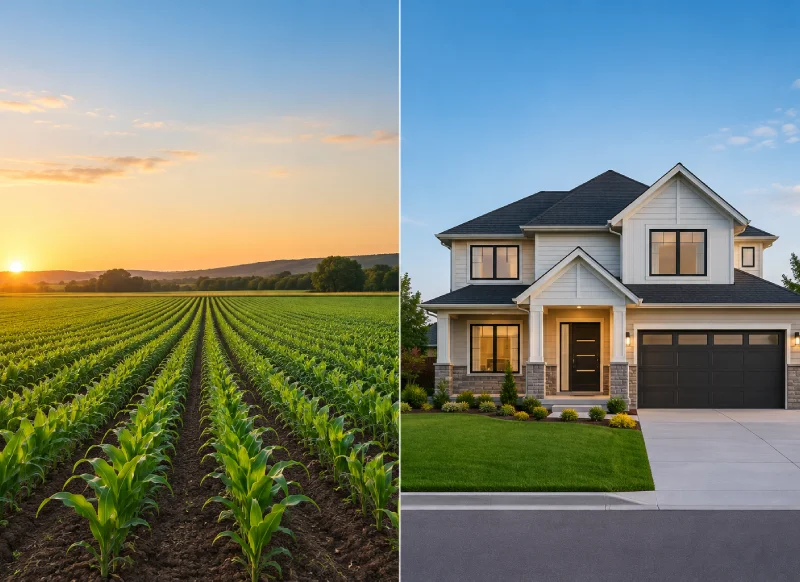
For decades, apartments, commercial properties and residential plots have been among the most familiar investment choices in India. But in 2026, investors are increasingly looking beyond conventional property ownership and exploring alternative investment options that combine land ownership with productive use.
One such option is managed farmland investment in India.
Unlike buying a traditional apartment or plot and managing everything independently, managed farmland can combine land ownership with professional agricultural management, infrastructure and long-term land development. This makes it an interesting option for investors who want exposure to land and agriculture without taking on the responsibilities of running a farm themselves.
But does managed farmland really make more sense than traditional real estate? The answer depends on your investment objective, expected returns, liquidity requirements and risk tolerance.
What Is Managed Farmland Investment?
Managed farmland investment generally involves acquiring an interest in agricultural land where farming or land-related activities are professionally planned and managed.
Instead of purchasing land simply to hold it, the investment may be supported by agricultural operations, plantation development, maintenance, irrigation, soil management and other services depending on the project.
This approach creates a different investment proposition: the land is not viewed only as a static asset but as a productive natural resource.
Triearth’s business ecosystem reflects this broader approach to land and agriculture. Its agro division focuses on sustainable agricultural initiatives including bamboo cultivation, organic fertilizers, vermicompost and agricultural trade, while its property division works in land acquisition, infrastructure development and strategic land banking.
Managed Farmland vs Apartment Investment
The biggest difference between the two is the nature of the asset.
An apartment is primarily a built property. Its value can depend on location, construction quality, demand, rental potential and surrounding infrastructure. Investors may generate rental income or hold the property for long-term appreciation.
Farmland, on the other hand, combines the value of land with agricultural potential. A well-managed project may offer investors exposure to both land appreciation and agricultural activity, depending on the structure of the investment.
For someone looking for passive income land investment, managed farmland can be attractive because professional management can reduce the day-to-day involvement normally associated with owning agricultural land.
However, investors should carefully examine what is actually included in the management arrangement and whether income is guaranteed or dependent on agricultural performance.
Comparing Returns
Traditional real estate can generate returns through two primary channels: rental income and capital appreciation.
Managed farmland can potentially provide a combination of land appreciation and agricultural-related income, depending on the project structure. But agricultural returns can be influenced by crop selection, weather, water availability, input costs, market prices and operational efficiency.
Therefore, comparing farmland and apartments purely on expected percentage returns can be misleading.
Instead, investors should evaluate:
- Initial investment and additional costs
- Potential capital appreciation
- Income-generation model
- Maintenance and management expenses
- Holding period
- Exit opportunities
- Tax and legal considerations
- Overall risk
The strongest investment is not necessarily the one promising the highest return; it is the one whose risk and return profile matches the investor’s financial goals.
Liquidity: An Important Difference
Liquidity is one area where traditional real estate can still have an advantage in certain locations.
An apartment in an established urban market may have a relatively broad pool of potential buyers and tenants. Farmland can take longer to sell because the buyer pool, land-use restrictions and documentation requirements can be more specific.
This makes managed farmland more suitable for investors with a long-term investment horizon rather than those expecting to exit quickly.
Investors should also remember that agricultural land transactions are subject to state-specific laws. In Maharashtra, for example, the Maharashtra Tenancy and Agricultural Lands Act contains restrictions concerning transfers to non-agriculturists, making eligibility and legal due diligence especially important.
Risk: Different Does Not Mean Risk-Free
Every investment carries risk.
Apartments can face vacancy, maintenance costs, changing rental demand, construction quality issues and market cycles. Farmland can be affected by weather, water availability, agricultural productivity, market prices, title issues and regulatory requirements.
Managed farmland may reduce operational involvement, but it does not eliminate investment risk.
Before investing, buyers should verify land title, ownership records, applicable land-use rules, development permissions, water availability, management agreements, projected expenses and the exact nature of ownership being offered.
Why Farmland Is Becoming an Interesting Alternative
The appeal of farmland goes beyond financial returns.
For many investors, land represents a tangible, long-term asset. When combined with professionally managed agricultural activity, farmland can offer a different experience from conventional urban property.
It also aligns with growing interest in sustainability, agriculture, natural assets and diversification.
Triearth’s focus on sustainable agriculture, bamboo cultivation, soil health and organic agricultural solutions demonstrates how land can be connected with productive and environmentally conscious activities rather than being treated only as a passive holding.
Which Investment Makes More Sense in 2026?
There is no universal winner between managed farmland and traditional real estate.
Traditional real estate may suit you if you prioritise:
- Rental income
- Established urban demand
- Familiar property models
- Potentially easier resale in liquid markets
Managed farmland may suit you if you prioritise:
- Long-term land ownership
- Portfolio diversification
- Exposure to agriculture
- Lower day-to-day involvement
- Alternative investment options in India
- A tangible asset connected with productive land use
For investors who already own apartments or conventional properties, farmland can also serve as a diversification strategy rather than a replacement.
Make the Decision Based on Your Goals
The right investment decision in 2026 should begin with a simple question: What do you want your investment to achieve?
If your priority is regular rental income and urban property exposure, an apartment may be more appropriate. If your objective is long-term land ownership with professionally managed agricultural activity, managed farmland deserves consideration.
Ultimately, managed farmland investment in India should be evaluated on the quality of the land, legal structure, management model, infrastructure, agricultural plan and exit strategy—not simply on projected returns.
At Triearth, the combination of real estate expertise and agricultural initiatives creates an ecosystem focused on transforming land and natural resources into long-term opportunities. With the right due diligence and a clear investment horizon, managed farmland can be a compelling addition to a diversified property portfolio in 2026.