


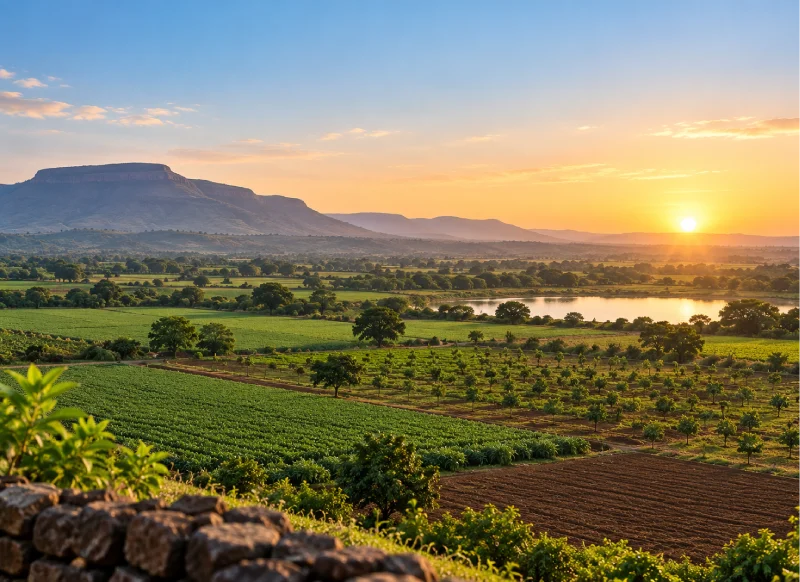
Maharashtra has always had a strong connection with agriculture, but agricultural land is increasingly being considered for another reason: long-term investment. With expanding cities, improving infrastructure and growing interest in tangible assets, many investors are exploring farmland as an alternative to apartments, commercial properties and other conventional investments.
But is agricultural land investment in Maharashtra actually a good idea?
The answer depends on the location, legal status of the land, ownership eligibility, development potential, agricultural productivity and your investment horizon. Farmland can be a valuable long-term asset, but it requires significantly more due diligence than simply comparing property prices.
Why Consider Agricultural Land as an Investment?
Unlike many financial assets, land is a tangible resource. Agricultural land can potentially provide value in two ways: through long-term appreciation and through productive agricultural use.
Locations with improving roads, connectivity, nearby urban development and growing economic activity can attract increasing interest over time. At the same time, productive farmland may generate agricultural income depending on the crop, farming model, water availability and operating costs.
This combination makes farmland interesting for investors looking for land investment returns and diversification.
Triearth’s business approach reflects this broader view of land. Its ecosystem combines real estate and agriculture, with Triearth Agro focused on sustainable agriculture and future-focused farming opportunities and its properties division focused on strategic land development.
Location Matters More Than Almost Anything Else
Not every piece of agricultural land will perform equally.
When evaluating farmland in Maharashtra, investors should consider:
- Proximity to major cities
- Road and highway connectivity
- Availability of water
- Soil quality
- Existing agricultural activity
- Nearby infrastructure development
- Accessibility throughout the year
- Surrounding land-use patterns
- Future development prospects
- Local demand for agricultural land
A cheaper property in a remote location is not necessarily a better investment than a slightly more expensive property with better connectivity and infrastructure.
For investors around Pune, for example, the broader region’s connectivity and expanding development can make land location an important consideration. But potential future development should never be assumed or treated as guaranteed appreciation.
Understanding the 7/12 Extract
One of the most important documents when evaluating agricultural land in Maharashtra is the 7/12 extract, commonly known as Saat-Bara.
It is a land-record document containing important information about a particular parcel, including details relating to ownership and land use, cultivation and other recorded rights or interests.
However, investors should not treat the 7/12 extract as the only document required for due diligence.
A proper verification process may also involve checking title documents, mutation entries, encumbrances, maps, boundaries, access rights, applicable restrictions and other revenue and registration records.
Maharashtra’s official land-records department provides digital land-record services and information relating to agricultural land records and restrictions.
Can Anyone Buy Agricultural Land in Maharashtra?
This is one of the most important questions for prospective investors.
Agricultural land cannot simply be treated like an ordinary residential plot. Maharashtra has specific laws governing agricultural land transfers.
The Maharashtra government’s land-records department states that Section 63 of the Maharashtra Tenancy and Agricultural Lands Act restricts transfers of agricultural land to persons who are not agriculturists, subject to specified permissions and exceptions.
Therefore, before considering farmland ownership in India, investors should establish whether they are legally eligible to purchase the particular agricultural property.
The exact position can depend on the buyer, land classification, location, transaction structure and applicable permissions.
Always obtain professional legal advice before entering into an agricultural-land transaction.
What About Tax-Free Agricultural Income?
Agricultural income is often described as “tax-free agricultural income”, but this phrase needs some context.
Under India’s income-tax framework, agricultural income is generally treated differently from non-agricultural income, subject to the applicable provisions and definition of agricultural income.
The Income Tax Department’s current guidance separately recognises agricultural income in income-tax return reporting. For example, its AY 2026–27 guidance identifies agricultural income as a distinct category for eligible taxpayers.
However, investors should not assume that every income generated from land is automatically agricultural income or tax-free.
The tax treatment can depend on how the land is used, the nature of the income, the transaction and the applicable provisions. Capital gains arising from the sale of land can also have separate tax implications.
A chartered accountant should therefore review the specific transaction before investment.
How Can Agricultural Land Generate Returns?
There are several potential sources of value from farmland.
1. Land Appreciation
The most straightforward investment thesis is long-term appreciation in land value.
Improved connectivity, infrastructure, economic activity and demand can potentially influence prices. However, appreciation varies considerably by location and market conditions.
2. Agricultural Income
Land that is actively cultivated may generate income through crops, plantations or other agricultural activities.
Returns depend on crop selection, productivity, water availability, labour, input costs and market prices.
3. Long-Term Asset Ownership
For some investors, the objective is not immediate income but ownership of a tangible asset that can form part of a long-term portfolio.
This is particularly relevant for investors who want to diversify beyond apartments and financial investments.
What Returns Should Investors Realistically Expect?
There is no reliable single percentage that can be applied to all agricultural land in Maharashtra.
A property’s future value depends on factors such as:
Location + land quality + infrastructure + demand + legal status + agricultural productivity + holding period.
Investors should be cautious about schemes that advertise exceptionally high or guaranteed appreciation.
Instead, compare the purchase price with recent transactions in the surrounding area, evaluate the property’s fundamentals and calculate the total cost of ownership.
Remember that registration charges, legal costs, development expenses, maintenance, agricultural operating costs and taxes can affect the actual return.
Agricultural Land vs Residential Property
For many investors, the decision comes down to choosing between farmland and conventional real estate.
Residential property may provide rental income and can be easier to understand from a financing and resale perspective. Agricultural land, on the other hand, offers exposure to a different asset class with agricultural and land-value potential.
Farmland may therefore be particularly interesting for investors who:
- Have a long-term investment horizon
- Prefer tangible assets
- Want to diversify their property portfolio
- Have an interest in agriculture
- Do not depend on immediate rental income
- Understand the legal requirements associated with agricultural land
It is not necessarily better than residential property—it simply serves a different investment purpose.
A Practical Agricultural Land Investment Checklist
Before purchasing farmland in Maharashtra, conduct due diligence across five areas.
Legal: Verify ownership, title, encumbrances, transfer eligibility and applicable restrictions.
Land records: Review the 7/12 extract, mutation records, survey details and relevant revenue documents.
Physical: Visit the property and verify boundaries, road access, water availability, soil and existing cultivation.
Financial: Calculate purchase price, registration expenses, legal fees, development costs, maintenance and expected agricultural expenses.
Future potential: Study surrounding infrastructure and development, but distinguish realistic prospects from speculative promises.
This process can significantly reduce the chances of making a decision based only on the property’s asking price.
Why Managed Agricultural Land Can Be Different
For investors who like the idea of farmland but do not want to manage agricultural operations themselves, professionally managed agricultural opportunities may offer a different approach.
The management model can potentially handle aspects of cultivation, maintenance, land management and agricultural operations, depending on the project.
This is relevant to Triearth’s broader approach. Through Triearth Agro, the group focuses on sustainable agriculture and future-focused farming opportunities, while its property business focuses on strategic land development.
However, investors should always understand exactly what the management agreement covers, what costs apply and how agricultural income or other returns are calculated.
Final Verdict: Is Agricultural Land a Good Investment in Maharashtra?
It can be—but only when the land and investment structure are right.
Agricultural land can offer long-term asset ownership, potential appreciation, agricultural income and portfolio diversification. Maharashtra’s diverse agricultural regions and proximity to major urban centres can make farmland an interesting investment category.
But farmland is not a guaranteed-return investment.
Before purchasing, investors should carefully evaluate the 7/12 extract, ownership and title, eligibility to purchase, water availability, location, accessibility, agricultural productivity, total costs and exit possibilities.
For investors willing to take a long-term approach and conduct proper due diligence, agricultural land investment in Maharashtra can be a meaningful component of a diversified portfolio.
The smartest approach is not to ask only, “How much can this land appreciate?” Instead, ask:
“Is this legally sound, practically usable, financially viable and suitable for my long-term investment goals?”
That question can make the difference between simply buying land and making a well-informed land investment.